
On weekdays, I get up at 5:30 a.m. and spend an hour going through my Anki cards from around 6:00.
Before I knew it, it had been 8 years and 11 months since I started Anki. It’ll soon be 9 years.
One day I wondered, “What does my Anki actually look like after these 9 years?” So I had Claude Code (an AI) analyze my Anki stats.
Once it’s all turned into numbers, the data is pretty interesting. What surprised me most was that a third of my 15,000 cards had been forgotten 10 times or more. ( ゚д゚)
Well, forgetting a word 10 times or more isn’t strange at all for me, but my most-forgotten card had been forgotten 100 times.
Still, I’ve always told myself that the trick is to forget. More than anything, the fact that I’ve kept going is my biggest progress.
In this post
・What 9 years of Anki looks like in numbers (about 950,000 reviews, a 1,273-day streak)
・How does Anki count “times forgotten” and “times reviewed”?
・My most-forgotten words ranking (No. 1 was forgotten 100 times (ノД`))
・How to analyze your Anki stats with Claude Code and AnkiConnect
This is my Anki data as of November 5, 2026.

- 1 9 years of Anki in numbers
- 2 Why I set the day to start at 7 a.m.
- 3 What are “times forgotten” and “times reviewed”?
- 4 A third of my cards were forgotten 10 times or more
- 5 My most-forgotten words ranking (top 20)
- 6 And the times-reviewed ranking
- 7 Still, I remember over 10,000 cards
- 8 How to analyze your Anki stats with Claude Code and AnkiConnect
- 9 Even when people say “just doing vocabulary is pointless”
- 10 Summary
- 11 Relearning my worst 5 with example sentences
9 years of Anki in numbers
Let’s start with the overall numbers.
| Item | Number |
|---|---|
| Cards | 15,270 (13 decks) |
| First review | November 18, 2017 |
| Total reviews | About 957,000 |
| Time spent reviewing | About 2,586 hours (about 108 days) |
| Daily average | 320 cards |
| Days studied | 2,991 |
| Current streak | 1,273 days (my longest ever) |
You can also add up all the review time, and it came to 2,586 hours. That’s 108 full days.
In hours, it’s hard to get a feel for it, but seeing it as 108 days really drives home how much small steps add up.
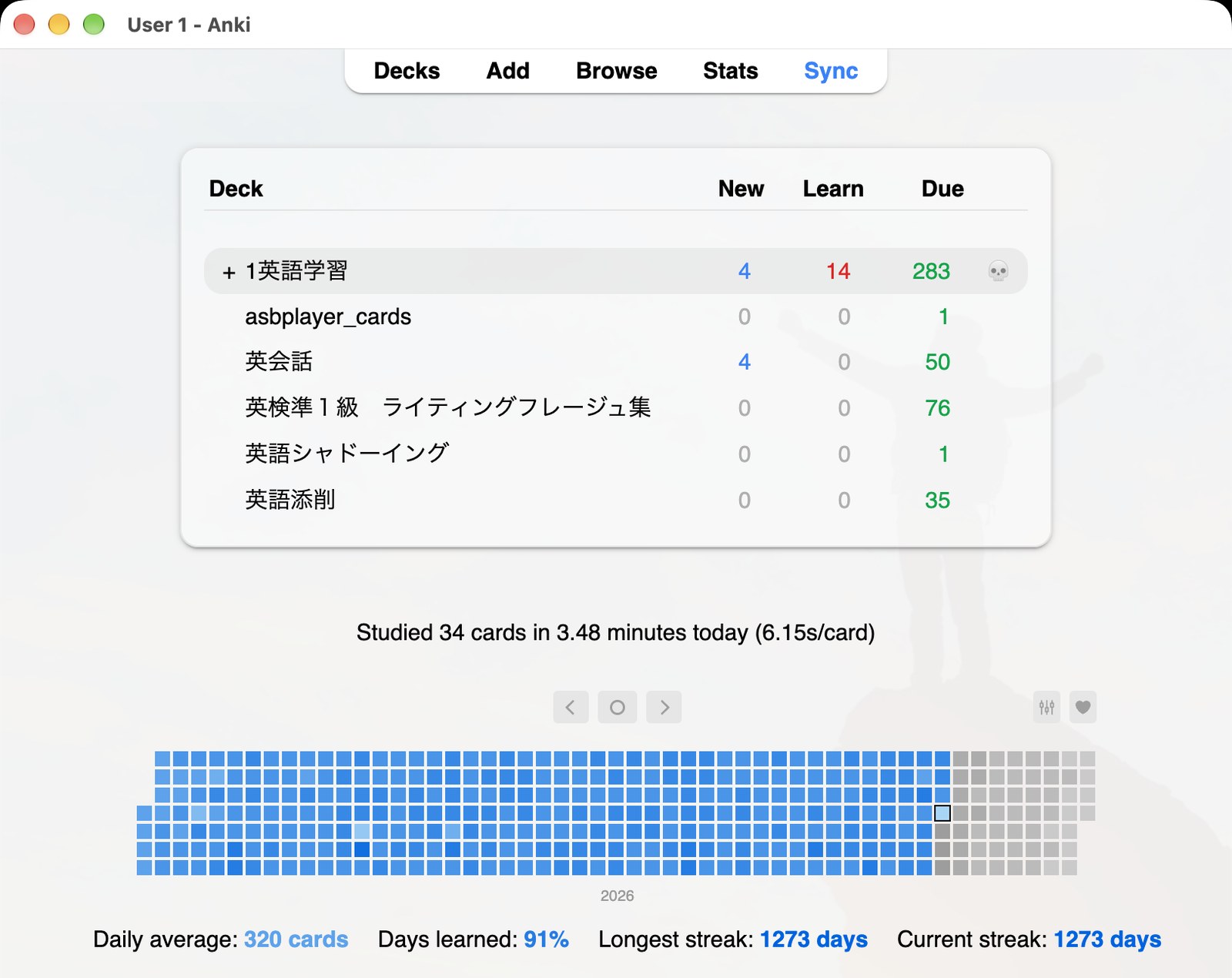
I use an add-on so I can also see stats on Anki’s home screen.
It says “Current streak: 1273 days.” My streak before this one was 1,115 days, and since April 2020, I’ve missed only one day: May 12, 2023.
There were also times when I flipped through cards really fast, just so I wouldn’t break the streak. A streak is surprisingly motivating.
Why I set the day to start at 7 a.m.
Anki has a “Next day starts at” setting, and by default it’s 4 a.m.
If I left it at 4 a.m., I’d have to finish my cards by 4 a.m. on weekdays, and when work was too busy or I got home late, I just didn’t have time at night. I wanted to be able to get up early and do them in the morning, so I changed it to 7 a.m.
It’s a habit now, so if I don’t review, it feels wrong—like I’d be letting down the version of me who has kept this going for so long. I think it also has the upside of forcing me to get up.
I wrote about this setting in an earlier post: Anki initial settings guide (in Japanese).
The hourly graph shows exactly that.
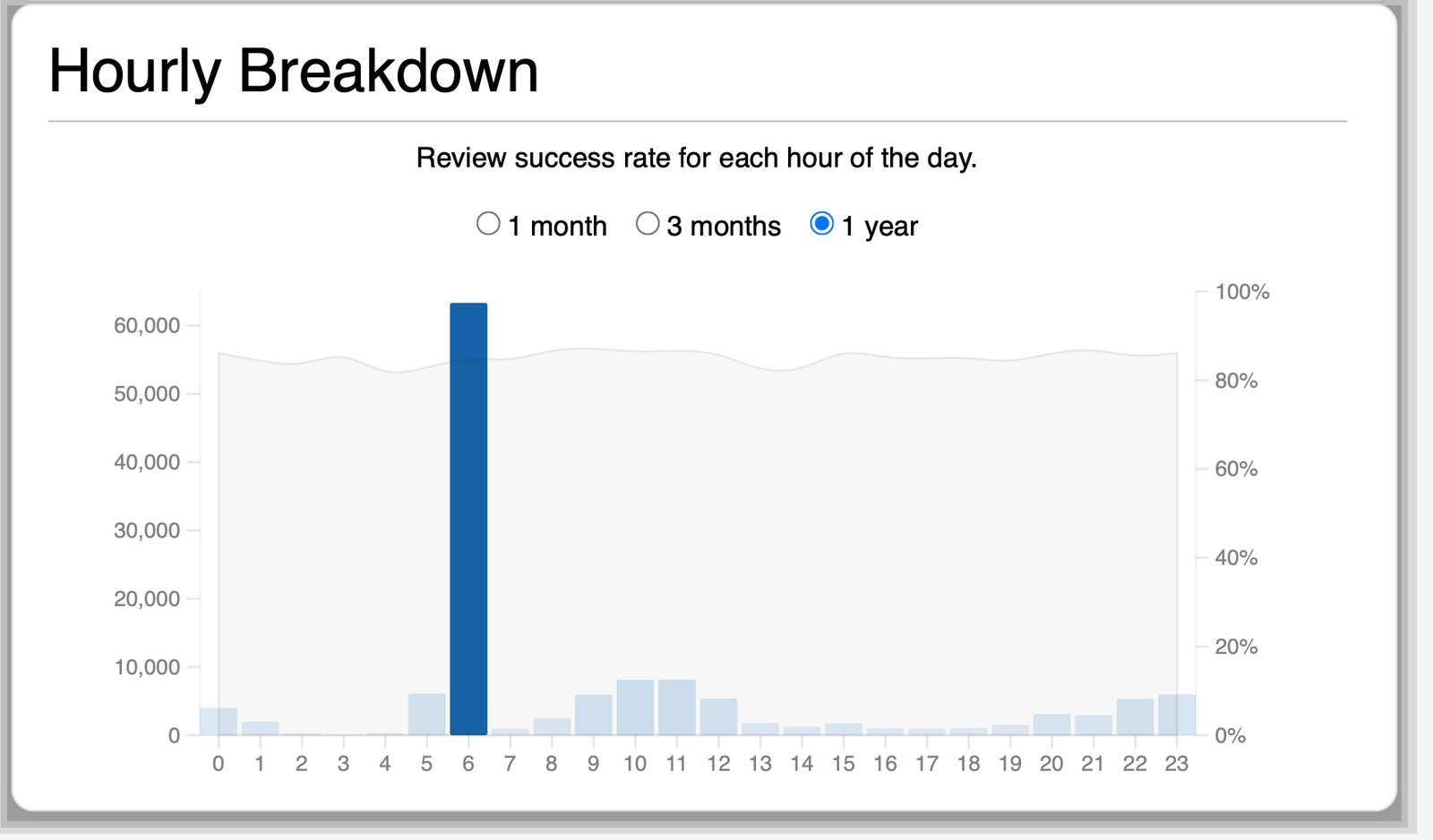
This is the hourly breakdown for the past year on Anki’s Stats screen. Only the 6 a.m. hour sticks way out. lol
Even across all 9 years, I reviewed the most in the 6 a.m. hour, averaging about 6 seconds per card. That’s about half the time I spend during the daytime hours (12–14 seconds), which are almost all weekends and holidays, when I can take my time with Anki.
I look at the English on the card, picture its meaning and move on. When you’re speaking English, if you need even one second to think because you don’t get the meaning, the conversation moves on and you lose track of it, so recalling words quickly is always better. Ideally, I’d grasp the meaning in a second (T ^ T)
But don’t feel pressured. The cards Anki shows you are the ones you remember poorly or haven’t learned yet, so as you see them more often, they’ll eventually go into your long-term memory. The key is to picture the meaning and say the word out loud.
What are “times forgotten” and “times reviewed”?
Before the ranking, let’s check how Anki counts.
- Times forgotten (“lapses” in Anki): the number of times you pressed “Again” on a card you had already learned. The official Anki manual also says, “When you click Again on a review card, it is called a lapse.”
- Times reviewed (“reps”): the number of times you answered a card. Any button counts as one. If you open a card’s “Info,” you’ll see a long table of which button you pressed on which day, and the number of reps is roughly the number of rows
Anki has four buttons, from left to right: “Again (red),” “Hard (orange),” “Good (green)” and “Easy (blue).” Pressing “Hard” doesn’t add to the times forgotten.
Here, let me be honest about how I press the buttons.
| Button | Share of presses (learned cards, 9 years) |
|---|---|
| Again (red) | 19.6% |
| Hard (orange) | 25.3% |
| Good (green) | 54.8% |
| Easy (blue) | 0.3% |
When I didn’t know the answer, I almost always pressed orange. Pressing red piles up review cards, so I only pressed red when I had no idea at all, or when I wanted to send the card back for another review.
As you keep using Anki, you gradually work out your own way of doing this. I think it’s best to start using it first and then decide your own rules.
Also, for cards whose review interval has grown to four or five months, when I’ve forgotten a little (but not completely), I sometimes press red on purpose to shorten the interval.
| Time since the last review | Red | Orange | Green |
|---|---|---|---|
| Up to 1 month | 20.3% | 27.6% | 51.8% |
| 1–3 months | 20.7% | 23.2% | 55.9% |
| 3–6 months | 12.4% | 15.6% | 71.9% |
| 6 months or more | 24.1% | 10.8% | 65.0% |
Looking at the analysis, red suddenly goes up once it’s been more than half a year. lol
So my “times forgotten” doesn’t include the times I forgot but let it slide with orange, and does include the times I pressed red on purpose to shorten the interval. It’s a little off from how many times I really forgot, but even so, the next ranking is quite something.
A third of my cards were forgotten 10 times or more
| Times forgotten | Cards |
|---|---|
| 5 or more | 8,257 (54%) |
| 10 or more | 5,155 (34%) |
| 20 or more | 2,103 |
| 50 or more | 173 |
| 100 or more | 1 |
Out of 15,000 cards, 5,155 had been forgotten 10 times or more. That’s about a third.

So instead of trying hard to memorize, forgetting is what matters. To get more chances to meet the words, let’s proudly say “Forgot it!” and keep flipping the cards!
My most-forgotten words ranking (top 20)
| Rank | Word | Times forgotten | Times reviewed |
|---|---|---|---|
| 1 | contentious | 100 | 391 |
| 2 | depose | 98 | 403 |
| 3 | avow | 95 | 373 |
| 4 | retain | 94 | 450 |
| 5 | graft | 92 | 375 |
| 6 | elation | 90 | 333 |
| 7 | intrude (on) | 89 | 394 |
| 8 | contradict | 87 | 430 |
| 9 | confer | 85 | 382 |
| 10 | contrive | 84 | 358 |
| 11 | valiant | 84 | 356 |
| 12 | perverse | 84 | 347 |
| 13 | visionary | 80 | 385 |
| 14 | blunder | 80 | 331 |
| 15 | considerate | 79 | 380 |
| 16 | admirable | 79 | 361 |
| 17 | not less than | 78 | 387 |
| 18 | acquit | 78 | 327 |
| 19 | rendition | 78 | 329 |
| 20 | prevalent | 76 | 360 |
Let me poke fun at myself over my worst 5—the words I pressed the red button on the most.
No. 1: contentious (causing arguments), 100 times
At a glance, it probably looks like continuous to me, so I always end up thinking it means something like “ongoing” or “continuing.” I think it’s because I haven’t really taken in the spelling.
No. 2: depose (to remove from power), 98 times
I know the noun deposition, but with depose, sometimes I get it and sometimes I don’t. I’ve been reviewing it for a long time, so the count has piled up, but there’s a gap between the times I know it and the times I don’t. That’s the interesting part, though. On top of that, it also means “to testify,” and testifying and removing someone from power aren’t similar at all・・・ Maybe that’s why it’s hard to remember.
No. 3: avow (to declare openly), 95 times
I always get confused with avert (to turn away, as in your eyes), which sounds similar. And it turns out I’d forgotten my avert card 46 times too. lol
No. 4: retain (to keep), 94 times
I finally managed to learn this one. It took quite a while. It also looks like regain. Retain is the verb of retention, meaning “to keep,” right? That’s when it finally clicked in my head.
I also mix it up with restrain.
No. 5: graft (corruption, bribery), 92 times
I learned this one as “bribery” too. But bribe, which I learned first, was so strong in my mind for that meaning that graft was hard to remember.
It looks like the main reasons I couldn’t remember them were “they look or sound like other words” (continuous, avert) and “I know the noun, but the verb confuses me” (deposition → depose).
Oh, and by the way, none of my worst 30 came from the deck I made from my Eiken Grade 1 vocabulary book yet. The top spots were all from the deck of words I looked up and added myself and my Duo 3.0 deck (a popular vocabulary book in Japan). My Eiken Grade 1 deck is still new, so it just hasn’t piled up the numbers yet.
And the times-reviewed ranking
| Rank | Word | Times reviewed | Times forgotten |
|---|---|---|---|
| 1 | retain | 450 | 94 |
| 2 | contradict | 430 | 87 |
| 3 | depose | 403 | 98 |
| 4 | intrude (on) | 394 | 89 |
| 5 | contentious | 391 | 100 |
| 6 | not less than | 387 | 78 |
| 7 | visionary | 385 | 80 |
| 8 | confer | 382 | 85 |
| 9 | considerate | 380 | 79 |
| 10 | graft | 375 | 92 |
The more you forget a card, the more often it comes up for review, so it’s almost the same lineup. The most-reviewed card was retain, at 450 times, which I’ve now learned.
Still, I remember over 10,000 cards
If I only talk about forgetting, I start feeling gloomy about myself・・・ so let me look at the Stats screen and get some confidence back.
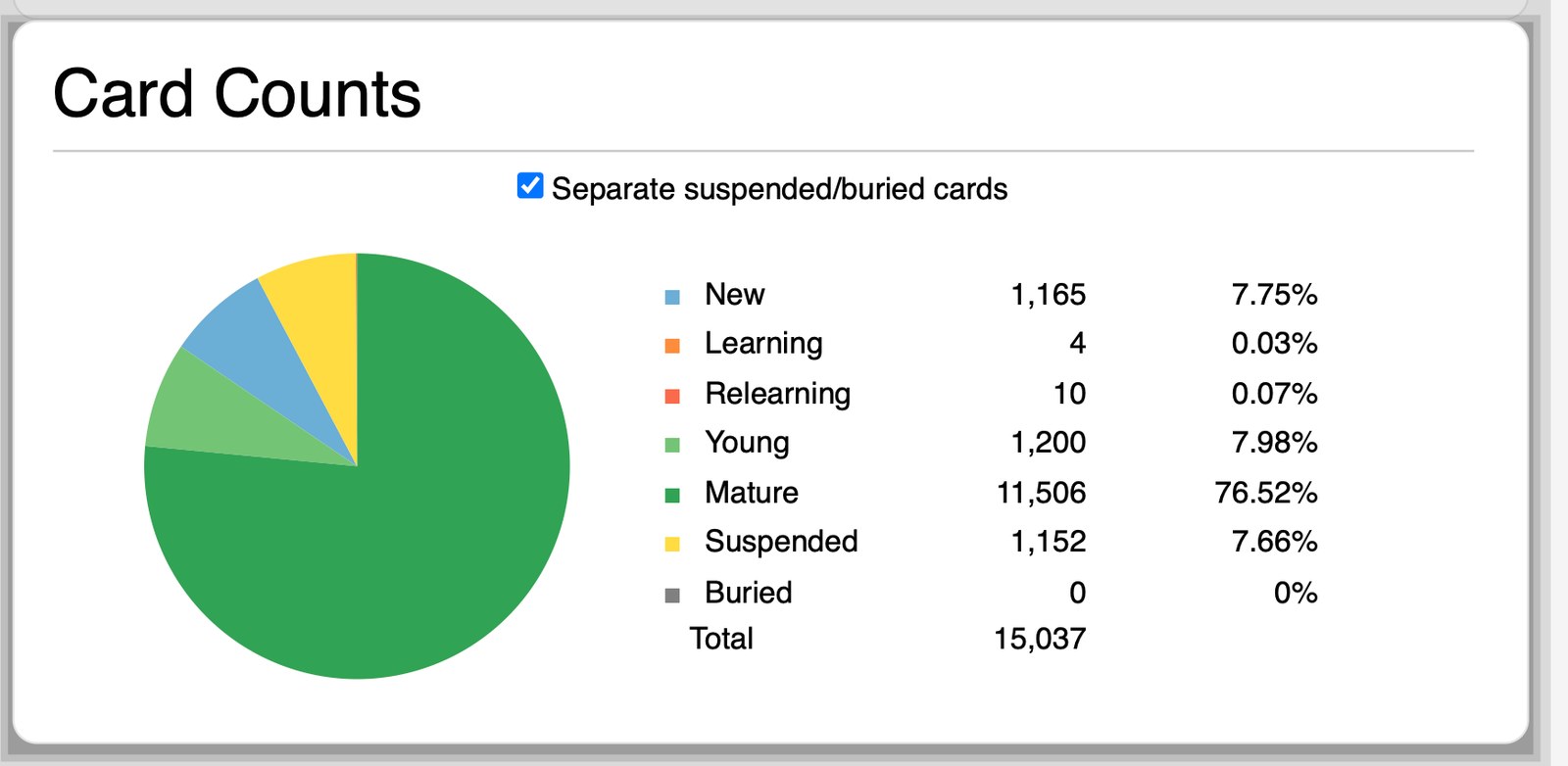
In my main deck, the well-learned cards (Mature) come to 11,506, or 76.5%.
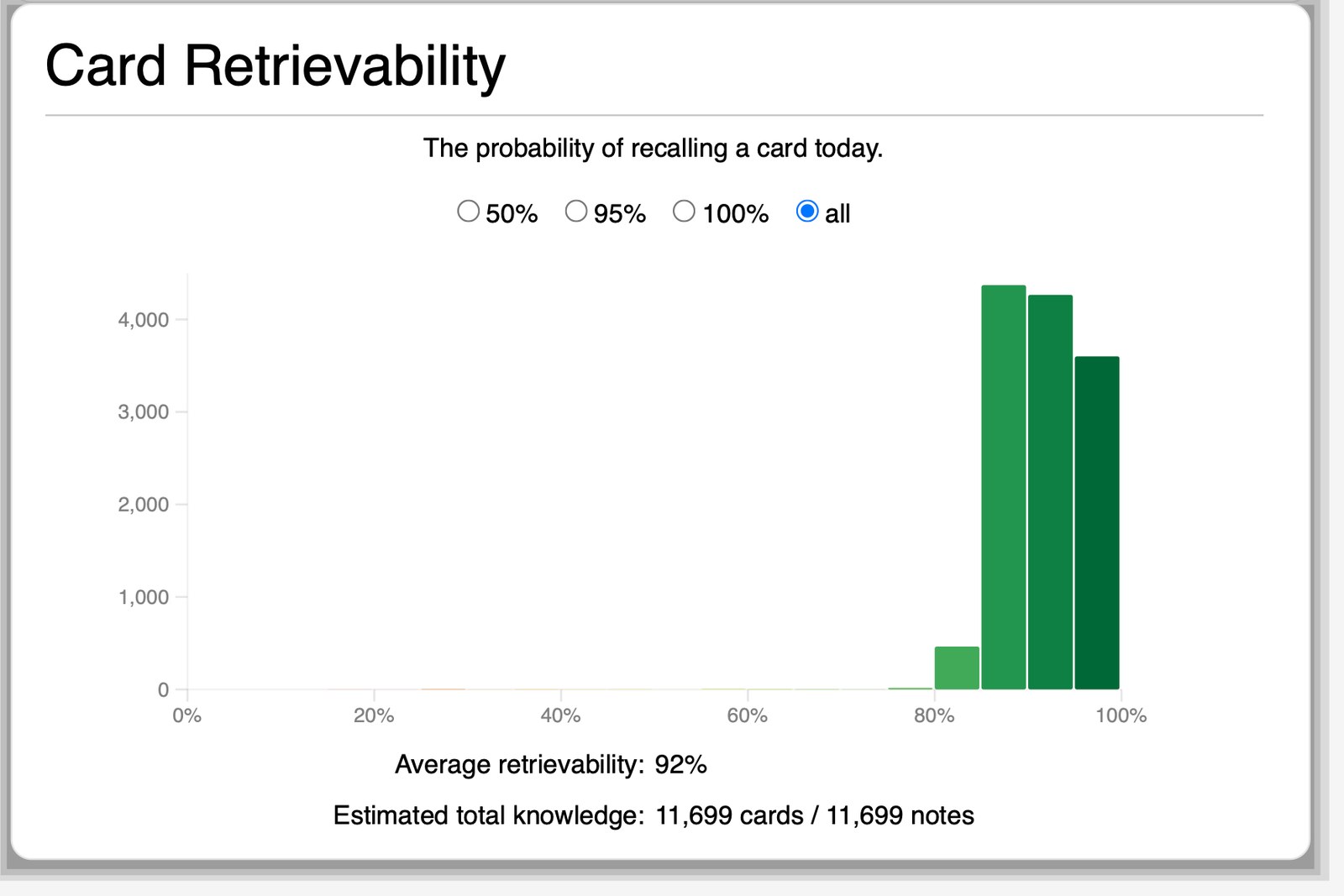
The average chance of recalling a card today is 92%, and the “estimated cards remembered” came to 11,699. My correct-answer rate for the past year is 86.0%.
Even if you forget a card 100 times, it really does stick♪( ´▽`)
Not bad, Suitman!
How to analyze your Anki stats with Claude Code and AnkiConnect
For anyone wondering, “How do you get AI to analyze your Anki?”, here’s how I did it.
I used AnkiConnect (an add-on that lets outside programs read and write Anki cards and review history) and Claude Code (Anthropic’s AI that runs on your computer).
- Install the AnkiConnect add-on in Anki (add-on code: 2055492159)
- Keep Anki open on your computer (AnkiConnect only works while Anki is open)
- Ask Claude Code in plain language, for example, “Use AnkiConnect to rank my cards by how many times I’ve forgotten them” (I asked in Japanese)
Through AnkiConnect, Claude Code added up the card information (times forgotten and times reviewed) and 9 years of review history, only reading the data. It didn’t change a single card.
I already use Claude Code and AnkiConnect to add new words to Anki, too: Adding vocabulary to Anki with Claude Code (in Japanese).
Even without Claude Code, you can do the same analysis if you have Python. Here’s the code that worked in my setup, exactly as it is (it only reads data).
import json
import re
import urllib.request
from datetime import datetime, timedelta

URL = "http://127.0.0.1:8765"
ROLLOVER_HOUR = 7  # change this to match the Next day starts at setting in Anki


def anki(action, **params):
    body = json.dumps({"action": action, "version": 6, "params": params}).encode()
    with urllib.request.urlopen(URL, body) as res:
        reply = json.load(res)
    if reply["error"]:
        raise RuntimeError(reply["error"])
    return reply["result"]


def front(card):
    first = min(card["fields"].values(), key=lambda f: f["order"])["value"]
    return re.sub(r"<[^>]+>", "", first).strip()[:30]


# 1) Top 20 cards by lapses (times forgotten)
cards = anki("cardsInfo", cards=anki("findCards", query="prop:lapses>=30"))
cards.sort(key=lambda c: c["lapses"], reverse=True)
print("Top 20 most-forgotten cards")
for i, c in enumerate(cards[:20], 1):
    print(f"{i:2d}. {front(c)}  forgotten {c['lapses']} times / reviewed {c['reps']} times")

# 2) Number of cards forgotten 10 or more times
total = len(anki("findCards", query="deck:*"))
lapsed = len(anki("findCards", query="prop:lapses>=10"))
print(f"\n{lapsed} of {total} cards were forgotten 10 or more times")

# 3) Days studied and the current streak
days = set()
for deck in anki("deckNames"):
    for review in anki("cardReviews", deck=deck, startID=0):
        t = datetime.fromtimestamp(review[0] / 1000) - timedelta(hours=ROLLOVER_HOUR)
        days.add(t.date())
day = (datetime.now() - timedelta(hours=ROLLOVER_HOUR)).date()
if day not in days:
    day -= timedelta(days=1)
streak = 0
while day in days:
    streak += 1
    day -= timedelta(days=1)
print(f"Days studied: {len(days)} / current streak: {streak} days")
Set ROLLOVER_HOUR to your own Anki “Next day starts at” setting. If it’s off, your streak will come out wrong, like mine did. lol
Well, if you ask an AI how to do it, it’ll explain things very carefully and clearly, so you can analyze your own learning right away. Give it a try ( ´ ▽ ` )
Even when people say “just doing vocabulary is pointless”
I’ve been doing vocabulary for 9 years. Some English-learning commentators say that “just doing vocabulary is pointless.”
But for me, Anki has been what keeps me motivated to continue with English. The feeling of “I don’t want to miss even one day” is what has kept me studying English—it’s what connects my days.
Learning from books or memorizing by writing just makes me sleepy, and I can’t keep it up at all. Anki is what suited me best.
Because of Anki, I found myself driven to go to the UK, and I’ve been able to keep communicating with people from other countries. For me, Anki is the biggest support that keeps me going with English.
Even if I forget a word 100 times, I’ll start flipping through my cards again tomorrow at 6 a.m. without getting discouraged. lol

Summary
- In 9 years: 15,270 cards, about 957,000 reviews and about 2,586 hours. An average of 320 cards a day, and a 1,273-day streak right now
- A third of my 15,000 cards had been forgotten 10 times or more. No. 1 was contentious, at 100 times
- Anki’s “times forgotten” is the number of times you pressed “Again (red).” Pressing “Hard (orange)” doesn’t add to it
- The words I can’t remember usually “look or sound like other words” or are verbs that confuse me even though I know the noun
- Even so, the estimated number of cards I remember is over 10,000
- With AnkiConnect and Claude Code, you can analyze your Anki stats just by asking in plain language
Relearning my worst 5 with example sentences
Here are my worst 5 again, with example sentences I made myself.
- contentious (causing arguments): Price increases are always a contentious topic at family dinners.
- depose (to remove someone from power): The king was deposed after years of protests.
- avow (to declare openly): He avowed that he would never give up on English.
- retain (to keep): Daily reviews help me retain new words.
- graft (corruption, bribery): The mayor was arrested for graft.
☕ Enjoyed this post?
I'm a Japanese blogger who spent 8 years relearning English from scratch.
If this post helped you, a coffee would mean a lot — thank you for reading!


Leave a Reply